When you want something, when you really, really want something, do you ask yourself any questions before you take that thing? You should. You should ask yourself a lot of questions. Questions like: Do I deserve this thing? How will taking this thing affect those around me? Is it legal to take or have this thing? Is it moral to take or have this thing? Should I give something back to replenish the thing I’m taking?
Can you imagine Donald Trump asking himself any of these questions even a single time in his long, long life of taking?
The Art of the Grift
It has become axiomatic to say that Donald Trump is corrupt. The man’s record of moral and ethical degradation goes back more than a half century and has been well documented. It’s as if Trump’s corruption exists at a molecular level. Try to find somewhere in his history a single righteous act in which he deprives himself of something (anything) so that another human being could benefit. It’s not there. If a novelist wrote a book with Donald Trump as the protagonist, editors would reject it; they’d say he is beyond a willing suspension of disbelief. No reader would be able to identify with a person whose character lacks a single, redeeming virtue. And yet, there Donald Trump is, serving a second term as the U.S. President.
Is Trump’s moral bankruptcy genetic or environmentally influenced? Probably both. The two key mentors in his life – men who had a profound influence over Trump’s sense of right and wrong – were his father Fred Trump and the lawyer/advisor of his early years, Roy Cohn. Both were themselves fundamentally dishonest men. But psychologists might also say that Trump’s mental pathologies, one of which is a disabling narcissistic personality disorder, engender behaviors wherein Trump sees everything in the world – the people, the wealth, the assets – as resources for his personal benefit. The combination of his mentors and mental illnesses resulted in a man who is seemingly devoid of human decency.
There is an art to Trump’s corruption, an art that’s been honed over the decades both by Trump’s mentors and by Trump himself. What came to him naturally at birth has been perfected to the point where the strongest government on earth seems powerless to stop his methodical dismantling of each and every guardrail designed to inhibit his corruption.
Trump is a grifter, a con man. Grifters have a few key insights into human behavior that they use to pick your pocket or steal your social security check. They create diversions. They capitalize on people’s tendency for compassion. They know that people are quick to make assumptions based on their predilections. Trump’s grift though operates on a much grander scale. Trump’s mark is not a businessman walking through Penn Station. Trump’s mark is the United States of America. He’s deployed the following tools to take down the United States.
- The Roy Cohn Playbook – Roy Cohn was a famous attorney who was hired by the Trump family to defend the Trump Organization when the U.S. Justice Department sued them in the 1970s for racial discrimination. Cohn was already a world-famous attorney (or rather, a world-infamous attorney) who made his name as Senator Joe McCarthy’s chief counsel during the Congressional Hearings of 1953-54. McCarthy was a megalomaniac who rose to power by accusing his enemies, including politicians, celebrities, and intellectuals, of being communists, ruining many of their lives (a different tragic chapter in U.S. history). Cohn was the strategist behind McCarthy’s witch hunts.
The U.S. case against the Trump Organization was solid. When African-American people applied for leases in Fred Trump’s apartment buildings, employees marked their applications with a “C” (for colored) at the top of the first page. That was a code to later deny them a lease. Enter Roy Cohn, who advised a young Donald Trump to do the following:
- Never, ever admit fault – Put adversaries on notice that they will need to prove their case while withstanding a withering defense, regardless of how sound their case is. Whether in a civil or criminal matter, launch a relentless media campaign claiming your innocence and victimhood. Never, ever, ever utter the words, “I was wrong.”
- Go on the offensive – Launch countersuits, accuse adversaries of the same thing you’re accused of, and find or create embarrassing things about an adversary that can be fodder for public consumption. Above all, force adversaries to spend money defending themselves in addition to the money they are spending to attack you.
- Claim victory, regardless of the outcome – Even if you lose in court, the public’s perception of the case can be shaped by your public statements. So tell them you won the case; at best they’ll believe you and at the very least you’ll confuse them.
- Capitalize on the U.S. justice system’s flaws – In its pursuit of a meticulous justice, the U.S. courts are willing to postpone timelines in both civil and criminal cases for years, allowing both petitioner and respondent to delay a judge’s “deadlines” for almost any real or contrived reason (as an aside, I spent my career as a financial expert witness, testifying in civil courts on accounting and valuation issues. I rarely saw a civil lawsuit be resolved in less than two years. One case – my record – took 14 years to resolve, simply because the court would not impose discipline on the parties). Simple discovery can take years, especially if one of the parties has unlimited funds to pay attorneys. And then, even after a decision is finally rendered, the moneyed party can take even more years appealing an unwanted decision to higher courts. Donald Trump has used this flaw – and an unwillingness of judges to recognize and disallow his strategy – to escape dozens of matters in which his culpability was obvious, enabling him to save millions of dollars, and, in some cases, criminal liability. U.S. Attorney General Merrick Garland hesitated for over a year to bring charges against Trump’s January 6th insurrection. In the process, a thoroughly intimidated Garland allowed Trump to escape justice.
- Manage the media – Trump understands that media companies are businesses and at the end of the day they will prioritize revenues over the news. His relationship with the media is a malignant symbiotic one in which he provides a strobe light of salacious news stories which the media feeds to an enraptured audience. The Trump Administration is a succession of turnpike car wrecks and we can’t help ourselves from slowing down to gawk. Every time we slow down, the media outlets earn the ratings that attract advertisers. One would think the so-called liberal media would decline to broadcast Trump’s daily dumpster fires in order to report more important stories. They don’t. Turn on CNN or MSNBC tomorrow. Watch it for 12 hours. You will get 11.5 hours of Donald Trump. Trump sells and no one knows that better than Trump himself.
- Flood the zone – As the only president in U.S. history who was impeached and removed from office (through resignation rather than conviction), Richard Nixon is the poster boy for American political corruption. Nixon made one mistake though. He allowed the Watergate scandal to drone on for two years. While it’s true he couldn’t stop it, he failed to make a key observation that is central to Donald Trump’s strategy: commit a new Watergate scandal every week. Trump understands that no single corrupt act will hold the public’s attention if a new abomination takes its place at least every week, if not sooner.
The key here is understanding how the media news cycle works. The fashion industry has to launch new fashion lines every year. Restaurants need to reinvent their menus every 4-6 months. Car manufacturers provide facelifts to existing makes every three years. The news media has to provide new stories every day. Trump has understood this since he was a young man and knows that whatever he does on Monday will be long gone by Wednesday because the news media can’t resell old inventory, especially if you provide them new inventory.
I do not intend to cover the full spectrum of Trump’s corrupt character in this essay. Such a task would be impossible. The New York Times writers Maggie Haberman and Jonathan Swan have devoted two non-fiction works (see below) to Trump’s pre-presidency and his terms in office, nearly 1,000 pages of detail, and their work barely scratches the surface; at the very least Haberman and Swan could write a new 500-page expose on Trump every six months.
Before reviewing Trump’s grifting highlights, it might help to briefly discuss what sort of man is inclined to the grift. Why do you make a living doing what you do while another man devotes his life’s energy to cheating? Why do most of us value the truth though me may not always tell it, while another man beholds the truth with utter disdain, hesitating to tell it even when he has nothing to gain in a lie?
We can understand a lot about a man by seeing how he treats the people who are closest to him. In Trump’s case, it would be his wives and children. Donald Trump is a serial philanderer. He cheated on his first wife Ivana with his second wife, Marla. He cheated on Marla with his third wife, Melania. He cheated on Melania with Karen McDougal and Stormy Daniels, the latter affair of which occurred while Melania was at home pregnant with Trump’s fifth child. Link these affairs (these are the affairs that we know about) with his statements on tape that he could grab women by their genitals and get away with it because of his celebrity. Link all these things with Trump’s misogynistic statements about the women he sees in his daily life:
- “Shut up piggy”
- “It must be a pretty picture, you dropping to your knees”
- “You could see there was blood coming out of her eyes, blood coming out of her wherever.”
- “Look at that face. Would anyone vote for that?”
Etcetera, etcetera, etcetera. Trump constantly makes comments about women reporters’ physical appearance – what they’re wearing, the color of their hair, and so on. This rich history of debasement speaks to what Trump thinks about women. To Trump, women are chattel. There is no respect there. Women are resources to be used. Women have value only in their physical attraction to males. Other than that, they serve no purpose.
But it doesn’t stop with women. According to people who’ve known Trump for years including one long-term employee of the Trump Organization, Trump has no friends. He has business associates. He has political allies. He has attorneys. But he has no human relationships with friends – men or women who choose to spend time with him because they value his companionship. There is a reason for that. Trump’s treatment of women is a tell for how he treats people in general. He uses the people in his life for what he needs, then moves on. Just ask Rudy Giuliani, Mike Pence, Jeff Sessions, Michael Cohen, Sidney Powell, Pam Bondi, John Kelly, Bill Barr, James Comey, James Mattis, Mark Esper, Rex Tillerson, Corey Lewandowski, Chris Christie, Mick Mulvaney, John Bolton, HR McMaster, Mark Milley, etc. His relationships with these people were purely transactional. He gave them temporary power and fame. By agreeing to associate with him, they gave him their integrity in return. Dealing with the devil doesn’t always turn out the way you anticipate.
We should take special note of what Trump’s Chief of Staff, John Kelly, said about Trump after leaving the administration. General Kelly is a retired Marine 4-star general and gold star parent whose son, Marine Lieutenant Robert Kelly, was killed in action in Afghanistan. Kelly was Trump’s White House Chief of Staff for a year and a half between 2017 and 2019. After his time with Trump, General Kelly said, “He is the most flawed human being I have ever met in my life.” John Kelly is not a man accustomed to idle chatter.
Now, on to the grift!
Consumer Product Branding Scams
Long before Donald Trump hit the big time grift as the President of the United States, he was working the small time grift. Smaller, but just as dishonest. Early on he specialized in consumer products. Thanks to the notoriety he gained from the hit television show, The Apprentice, which ran for 15 seasons between 2004 and 2017, Trump learned he could slap the Trump name on consumer products and the public would buy them. It’s called branding. We buy Trump products for the same reason we pull into McDonald’s parking lot – we know the name. The difference though is that the McDonald’s brand was built over decades providing a solid, familiar product of uniform quality. Whether you patronize McDonald’s or not, the company’s products are built to attract consumers into a long-term relationship. The Trump products were, well, not.
The Trump products fell into one of two categories: 1) totally fraudulent crap that cost little or nothing to produce; and 2) regular products that were marked up to nonsensical selling prices since they had the Trump brand on them.
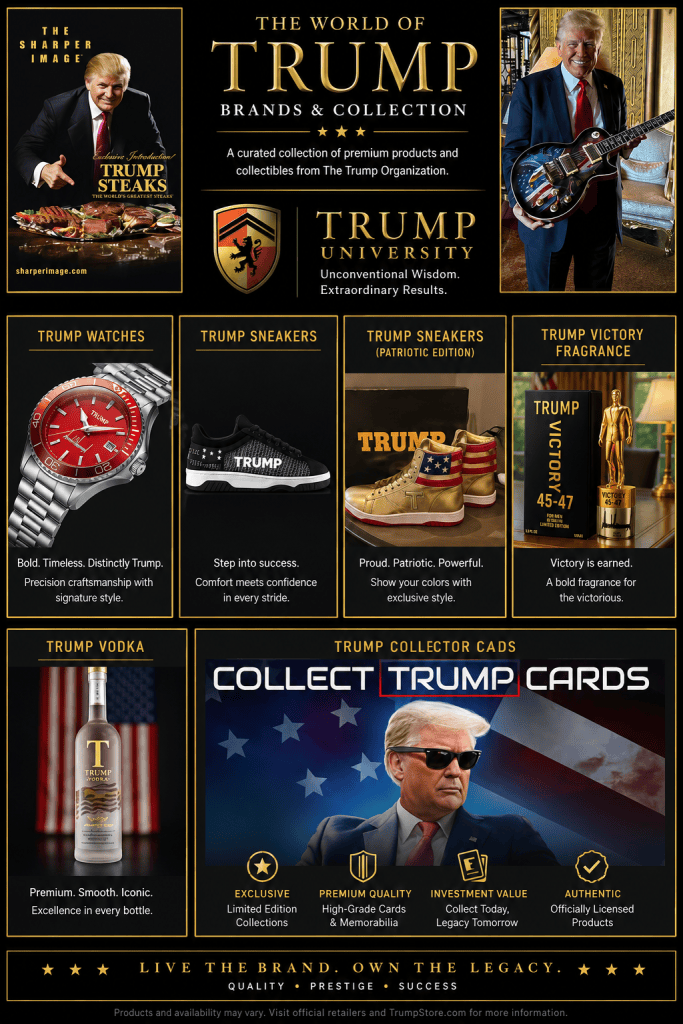
- Trump University – Founded in 2004, TU operated from 2005 to 2011. TU advertised itself as a real estate training program started by Trump, Michael Sexton, and Jonathan Spitalny. The “university” offered courses in real estate, entrepreneurship, and asset management. The curriculum was supposed to be taught by seasoned real estate professionals but courses were actually taught by novices who were learning the material the same time as the customers. Students were also pressured to sign up for “mentorship packages” (supposedly taught by people who actually knew something about real estate) for thousands of dollars. Complaints appeared almost immediately, then came the lawsuits, and finally the State of New York sued TU for $40 million in a class action case. Trump settled for $25 million. No one knows what he made over its six years of operation.
- Trump steaks – This was a simple branding operation. The steaks were real, marketed through QVC and Sharper Image in 2007. They earned mediocre rankings in blind taste tests. However, the prices were exorbitant for the time period. $199 got you two ribeye steaks, two filet mignons, and twelve hamburgers. On a per pound basis Trump steaks cost four to five times as much as comparable products from a supermarket. The venture failed within months. Trump was too greedy for his own good.
- Trump watches – These products have all the glitzy appearance of a Rolex, but with far more mundane quality. They are manufactured by a company called “TheBestWatchesonEarth, LLC,” located in Sheridan, Wyoming. I am not joking. That’s really the name of the manufacturer. The components are sourced from China. Trump watches come in many styles and colors, ranging in price from $599 to $100,000 (yes, one hundred thousand dollars). They are on sale now! Do yourself a favor. If you want a watch, buy a Seiko watch for $150. It will last twice as long.
- Trump guitars – Is there nothing this man won’t sell his name to? Trump guitars are mostly of the electric type, selling for $500 to $5,000. Like his watches, the guitars are sourced in China. The guitar body copied the Les-Paul style, prompting a lawsuit. According to analysts, the guitars have nowhere near the quality suggested by the price. A Fender Telecaster can be bought far cheaper, with a much higher quality.
- Trump vodka – The vodka was basically the same scam as the steaks and lasted about as long. The base bottle was $30.00, slightly more expensive than other high-end brands at the time. Of course, you could go for “premium” bottle which cost up to $5,000. In the end, it was just another bottle of vodka and evidently, vodka drinkers weren’t easily bamboozled. Trump vodka enjoyed a 5-year scam, from 2005 to 2010.
- Trump sneakers – The original was an unimaginably hideous high-top gold sneaker, emblazoned with a “T” and an American flag, on sale for $399 a pair. A whole range of footwear followed. Interestingly, the Trump footwear is made in Sheridan, Wyoming, the same small town that makes Trump watches. The shoes range from $199 to $499. People are now trying to sell them on eBay for thousands of dollars. One imagines the market is not defined by people who actually need footwear, as these people can buy a higher quality, longer lasting pair of Nikes for $89. The assumption is that Trump crap will one day be worth something to people who collect crap. Maybe. Probably not.
- Trump non-fungible tokens – To me, the whole concept of NFTs is a mystery wrapped in an enigma secured in a box of unadulterated bullshit. Non-fungible tokens are basically an online version of what baseball trading cards were back in the day. These cards sell for $99 each and depict Donald Trump as a cowboy, astronaut, superhero, race car driver, etc. – there are 45,000 of them. It’s advertised that if you buy a bulk of them you get to have a VIP drink with Trump. I’ve spent some time trying to understand what would drive a person to purchase a Trump non-fungible token. My ruminations proved to me that there are things that grifters know about human behavior that will forever be a mystery to me.
- The Trump Bible – Yes, you read that correctly. Trump even put his name on the Bible, which is marketed under his name as the “God Bless the USA Bible.” The bible is the King James version, but adds copies of the U.S. founding documents, the Declaration of Independence, the Constitution, etc.
I could go on, but you get the picture. None of the above products are illegal. Trump does not directly own any of the companies that make these products (or at least that’s what he says). He makes his money by leasing his name to them. Clearly, all of these Trump consumer products capitalize on people’s stupidity. In every case, consumers can purchase legitimate, higher quality similar products for far, far less money. Many of these products appeared soon after the Apprentice first aired in 2004. Only the IRS knows how much Trump earns from these seemingly endless branding deals; or maybe it would be more accurate to say that only the IRS knows how much Donald Trump reports that he earns on the deals.
Tax Scams
According to Trump he has been under IRS audit for well over a decade. Since the IRS does not comment publicly on audits of private citizens, we do not know if this is true. While it is certainly likely that the IRS would audit a taxpayer like Trump, it is unlikely that such as audit would take 10+ years.
Trump and his family have been observed in the following tax scams over the years:
- Evading 90% of inheritance tax – Donald Trump’s father Fred Trump died in 1999. His mother died in 2000. Over his career Fred Trump built a significant real estate empire mostly in Queens and Brooklyn, New York City. Reportedly his holdings consisted of nearly 30,000 apartments, single family homes, and row homes. These residences were rented to families and individuals who lived in New York. At the time of Donald Trump’s parents’ death, the U.S. Federal Tax code taxed inherited estates at 55% of the amount over the decedent’s lifetime exclusion which was then $650,000. So, for example, if an individual died with an estate worth $2,000,000, the estate would have to pay tax of $742,500. Of the total estate, $650,000 would be passed down free of tax and the rest would be taxed at 55%. In Trump’s parents’ case, the entire real estate portfolio would need to be formally appraised by real estate appraisal experts. Typically, both the estate attorneys and the IRS would hire their own valuation experts and an agreement would either be reached on the real estate value, or the difference would be litigated in U.S. Federal Tax Court. Once decided, the real estate would be taxed as described above. Fred Trump’s real estate empire was worth, by all accounts, at least in the neighborhood of $1.0 billion dollars.
According to the New York Times, which analyzed the related public records at the time, the Trump heirs paid $52 million in inheritance tax. As shown below, the tax owed should have been closer to $550 million.
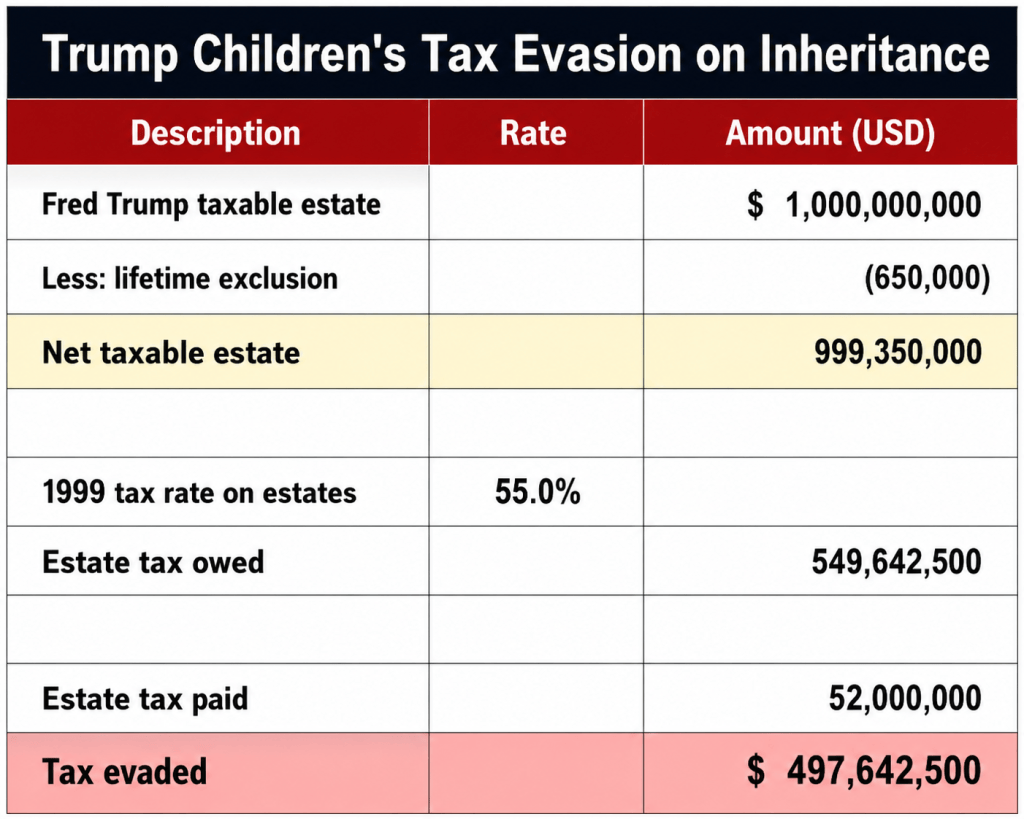
The issue here is that the value of real estate is subjective. One appraiser may come up with one value and another with a different value. But there is never a realistic difference of opinion of 90% of value. If that’s the case, one, or both of the appraisers either erred or are lying. The likelihood here is that Trump appraised his father’s real estate portfolio at 10% of its real value and paid tax on that rather than retaining an independent appraiser to opine on the fair market value.
The IRS never challenged the estate tax return. When the New York Times published the above evidence, Trump’s attorneys accused the Times of publishing a false and highly defamatory story. But, interestingly, Trump, who sues virtually everyone, did not sue over this story. Why? Because all of his tax records would have been subpoenaed in discovery; he would have put himself in a position of having to prove the Times was wrong, which means he would have had to prove his father’s estate was actually worth 10% of its true value. That wasn’t going to happen. Today, the matter is moot. Even if a criminal tax fraud is suspected, Trump is well beyond the 6-year statute of limitations.
- Adding fraudulent expenses to the company’s income statement – This is the most common tax evasion scheme in the corporate world (as well as on personal income taxes). Companies are only allowed to deduct real, operating expenses from their income statement. It is common though for taxpayers to add exaggerated or completely fraudulent expenses which lower taxable income. One common scheme is to create a management company. It works like this.
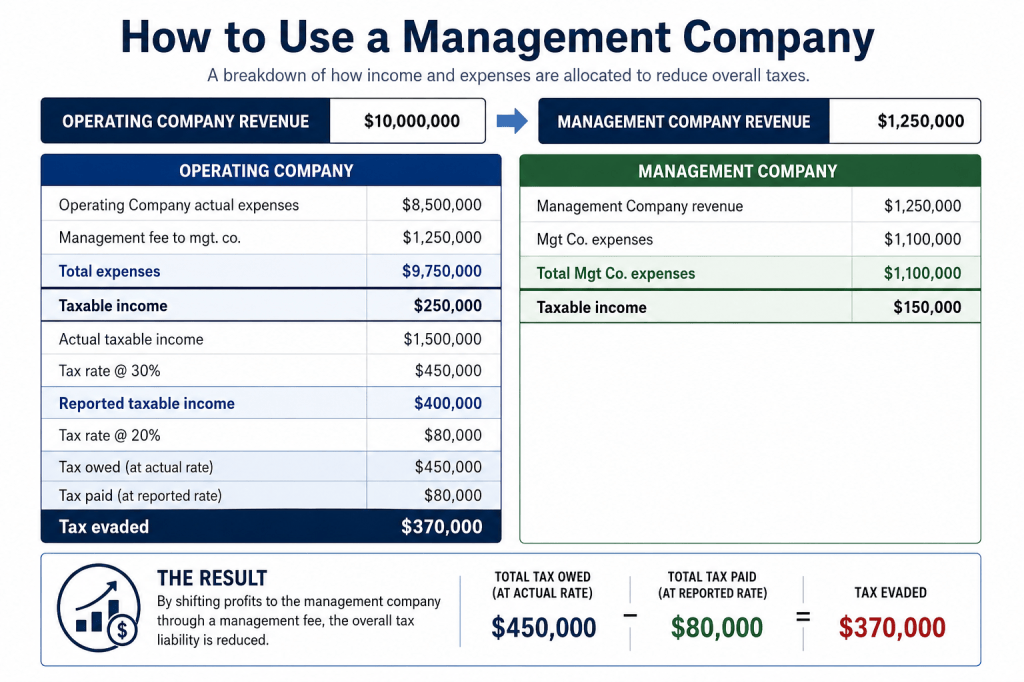
In the example above, the owners of the operating company set up a bogus management company which provides “management services” to the operating company. In fact, though the management company may be a legal entity, it provides no real function to the operating company. But it does allow the operating company to bleed expenses over the management company which then lists all manner of its own “legitimate” expenses (rent, utilities, salaries, etc.). In reality, the expenses being listed by the management company are non-operating (salaries for unemployed family members, tuition payments, country club dues, the vacation home in St. Croix, etc.). Management companies could be legitimate, but usually only when a separate, arms’ length third party is hired to manage all or certain parts of the operating company. In my practice I’ve actually seen management companies which themselves have management companies. The tax fraud is in creating as many profit/loss statements as possible on which bullshit expenses can be listed. With each additional income statement, an IRS audit becomes more complicated, more expensive, and unappealing from the government’s point of view.
The Trump Organization has made copious use of the management company tax scheme over the years. One example was a company called All County Building Supply and Maintenance Company (“ACBS”). ACBS purchased the building supplies needed to do the maintenance and repairs for the 30,000 properties owned in the Trump Organization. It then grossed up the cost of the supplies and sold them to the Trump Organization (the obvious question is why wouldn’t the Trump Organization just purchase these supplies itself). ACBS had no purpose other than to siphon profits from the father and distribute wealth to the children to evade inheritance tax. It also allowed the father to report lower income, thereby enabling rent increases on rent controlled buildings.
- Inflating real estate value to obtain loans – As discussed above, Trump was willing to grossly undervalue his real estate to avoid paying inheritance tax. He was also willing to do the opposite to obtain bank loans. Trump overvalued his properties between 2011 and 2021 to the tune of $1.0 to $2.2 billion dollars. Properties included Trump Tower Penthouse, Mar-a-Lago, Seven Springs Estates, and 40 Wall Street. The motive was to obtain both bank loans and insurance policies at favorable rates. The New York State Supreme Court held the Trump Organization liable for persistent civil fraud in these cases, levying a fine of $454 million.
Don’t Pay Your Bills
Here is a tried-and-true way to save money: don’t pay your bills. Donald Trump applied this strategy early and often while running his New Jersey Casinos.
- Subcontractors – Trump purchased the Atlantic City Hilton in 1985 and the unfinished Taj Mahal in 1988 and opened them as Trump Castle and Trump Taj Mahal, respectively, after extensive refurbishing and construction. Trump refused to pay the invoices for over 250 contractors and subcontractors on the casinos as well as Trump Plaza and several properties in Florida. The contractors included painters, glaziers, plumbers, carpenters, electricians, etc. Trump made it a point to hire small contracting companies on these jobs. When the work was completed, he either refused to pay, or offered 10 to 30 cents on the dollar. If the contractors refused, he told them to sue him, knowing full well they were unable to retain attorneys to fight his army of law firms as well as defend the frivolous lawsuit that he would bring against them. I personally know one such contractor, Ted Friel. The Edward J. Friel company was a small, successful cabinet maker outside Philadelphia. The company was hired to install the cabinetry in Trump Plaza for $400,000. In 1984, after finishing the work, Trump offered to pay Friel pennies on the dollar. Friel’s attorneys told him their legal bills would surpass the amount awarded after an undoubtedly long legal fight. The loss resulted in the company’s bankruptcy in 1989. Multiply the Friel case by 250 and you have Donald Trump’s art of the deal.
- Trump’s Bankrupted Casinos – The story behind Trump’s six bankruptcy filings on his three Atlantic City casinos is long and complicated, involving several different co-owners, bondholders, and creditors. These bankruptcies are often cited as evidence of Trump’s lack of business acumen when in fact, the opposite is true. They are compelling evidence of his lack of ethics and basic morality. I cite them here as evidence of Trump’s master class on how to grift.
Back in the 1980s Trump took a page out of the corporate raiders’ textbook which later evolved into the private equity leveraged buyout business model. In this model, you buy a quality business that for some reason is flailing (poor management, lack of distribution, bloated overhead, etc.). The purchase price for the business is cheap due to its vulnerabilities. After the acquisition, you use the company to borrow as much money as possible, withdraw massive salaries and management fees from the company for yourself (mostly from the loan proceeds), rendering the business a highly leveraged, maximum risk enterprise. This is exactly what Trump did with his Atlantic City casinos. He started by borrowing from banks – usually at junk bond rates well above 10.0% – then took his casino company public, effectively getting additional funds from public investors. While other Atlantic City casinos thrived throughout the 1980s and early 1990s, Trump’s casinos did poorly. And yet, Trump did well. Very well. He rarely if ever invested his own money. In fact, he did the opposite, by moving personal debts on to the casinos’ books. He withdrew salaries and bonuses in the millions for himself. Banks, bondholders, and investors did what people did when they bought his bullshit steaks, sneakers, and real estate courses. They assumed the Trump name meant quality. In fact, it was a sham and when the bankruptcies cleared, Trump walked away with his millions and the creditors were left holding the bag.
The Trump “Charitable” Foundation
How would you like to never again pay income taxes? Sound good? Well, it’s easy. Go to your attorney and have him set up a tax-exempt charitable foundation. Call it the John Doe Charity Foundation (JDCF). Then go to your employer and tell him to send your salary checks as donations to the JDCF. When you pay your mortgage, car payments, grocery bills, restaurant tab, utilities, etc. you write checks on the JDCF account. Since JDCF is a tax-exempt charity, you don’t pay income tax. It’s a good plan except for one thing. It’s illegal. That didn’t stop Trump.
Donald Trump set up The Donald J. Trump Foundation (DJTF) in 1988 as a tax-exempt charitable organization to receive money from outside donors and from royalties from the publication of his book, The Art of the Deal. In truth, the Foundation was a scam from the beginning, although it took 30 years before the legal authorities recognized it as such, shutting it down in 1988.
On paper the idea was for DJTF to receive donations and royalties as tax-exempt income and then to exclusively make donations to worthy charities. Royalties from his book constituted taxable income if he received it personally. By redirecting the royalties to the Foundation, the income became tax-free, as it should be if the intention was to redistribute funds out to charitable causes. The problem is, the money came in and was used for non-charitable purposes. Much of it was used to settle personal and business legal disputes, make contributions to political campaigns, finance his own presidential campaigns, curry favor with public figures, and, incredibly, on multiple occasions, purchase portraits of Trump at auctions. Trump and his children were board members, though they never met on Foundation business.
Trump did not try very hard to hide solicitations to the Fund. A better term than solicit might be ‘shake down.’ If you needed something from Trump or his family, he might give it to you in return for a donation to DJTF. Personal appearances and speeches that he and family members made were often reimbursed by “donations” to DJTF.
Essentially, The Donald J. Trump Foundation was a slush fund. Income went into the Foundation to avoid personal taxation, and was paid out for a variety of personal reasons. Actual real charitable donations were occasionally made, but almost always overstated. It was not unusual for Trump to publicly announce significant donations to charitable causes and then either never pay the money, or pay a fraction of the pledged amount. Such non-donations include pledges to veterans’ causes, the Twin Towers 9/11 fund, and the National Museum of Catholic Art and History which was neither a museum nor related to the catholic church.
Clemency for Cash
One of the more embarrassing functions of the modern Presidency is the pardon system. The founding fathers’ intention was to give the executive branch the ability to give clemency to worthy individuals who were victims of a judicial system that at times could go awry. In modern times presidents have used it usually in their final days in office to release political allies and friends convicted of federal crimes for sometimes dubious reasons. Having said that, Donald Trump has turned the pardon system on its head. In his second term in office, a mere 18 months, he has given 1,700 pardons, 1,500 of whom were January 6th insurrectionists who attacked the U.S. Capitol building and assaulted Capitol police.
The more impressive corruption though is in the remaining 200 pardons. Several of these cases came from convicts whose agents managed to “donate” cash to various Trump or Republican aligned institutions. Within the administration a pardon racket has emerged, with Trump insiders and lobbying firms advertising that they can get a pardon case in front of Trump for a fee ranging from $2 million to $5 million. Like much of the Trump Administration’s corruption, details will not likely come out until years after the MAGA nightmare has played its course. Certainly, there is no chance corruption investigations will occur while MAGA reigns.
Trump’s Business Dealings
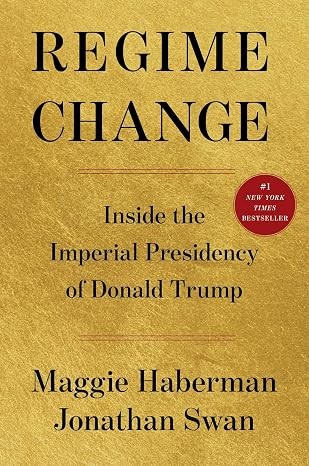
For a full exposition of Donald Trump’s evolution as a master grifter, I recommend two books written by New York Times columnists Maggie Haberman and Jonathan Swan:
- Confidence Man: The Making of Donald Trump and the Breaking of America, by Maggie Haberman and Jonathan Swan, Simon & Schuster, 2022
- Regime Change: Inside the Imperial Presidency of Donald Trump, by Maggie Haberman and Jonathan Swan, Simon & Schuster, 2026
The 2022 book highlights Trump’s development from childhood, covering his relationships with family members, authority figures, and his evolution as a real estate developer. This book speaks more to the same topic of this essay: Trump’s fundamental dishonesty, which appears almost immediately in his childhood and remains undiminished throughout his life. The second book covers the disaster which has been Trump’s two terms in office.
Both Fred and Donald Trump were corrupt businessmen. As discussed above, they did not hesitate to institutionalize racial discrimination in their leasing practices. What is even more disturbing were the ways they kept African- Americans out of their buildings. The administrative policy was communicated to employees freely, without shame or hesitation. If you worked in the Trump Organization you were instructed how to send black people elsewhere. Plain and simple. You either complied or you didn’t work for the Trump Organization.
There are dozens of examples of ethical and moral turpitude detailed in Haberman’s books. One such story involves the murky construction and marketing of Trump SoHo, a 46-story Manhattan condominium/apartment high rise off the Hudson River. This building includes everything: Russian money, broken zoning laws, illegal marketing practices, and even a dead construction worker. The truth about the building has never been fully uncovered. The New York District Attorney’s office dropped its investigation after Cyrus Vance, the NYC district attorney at the time, received two 5-figure campaign contributions (which he later returned).
The building site was not zoned residential but a permit was nevertheless granted to the lot’s owner, the Bayrock Group. The site was a cemetery for abolitionist African Americans in the 19th century, which became evident immediately after breaking ground when human bones turned up in abundance. Construction did not stop though. Testimony from Bayrock’s former employee indicates that the firm was a money-laundering operation for Russian oligarchs. The project was proposed to Trump by two companies, the Bayrock Group and the Sapir Organization, both operated by Russian immigrants. Although the building permit was issued, the site was still not zoned residential, so condo buyers could not get mortgages to finance their purchases. They had to pay cash. This attracted mostly foreign buyers, specifically from Russia, Latin America, and Europe.
All along Trump has maintained ignorance of civil and criminal wrongdoing in the SoHo project since his only involvement was to lease his name to the building owners and to provide operational oversight. However, Bayrock and Sapir say Trump ran the whole show. Trump’s children were actually in charge of marketing the condo units and their sales techniques were, at best, questionable. When units were shown to prospective buyers, they were told the building was already 60% sold, when in fact only 15% of the units has been sold. This practice counts for fraud in New York. It’s an age old grift: “you better buy now; there’s only a couple of these things left. They’ll be gone tomorrow.”
Buyers sued. Trump settled those suits – something he rarely does – for 90% of their petition, thus ending the civil case. The criminal case, as discussed, was dropped by Cyrus Vance. Trump invested none of his own money but did receive a 17% interest as part of the branding deal.
To this day, none of the apparent illegalities, and the potential recurring implications of the illegalities, have been, or are being, pursued. Where did the financing come from? Was it Russian oligarchs washing money in U.S. real estate? Does Donald Trump still have a relationship with these investors? Why were the New York zoning laws and fraudulent marketing laws overlooked? Why was Trump, whose tendency was to react to lawsuits with countersuits and long, drawn out civil trials, so anxious to settle with the condominium buyers, especially when, to listen to him, he was only on the margins of the deal? His only supposed connection was a branding agreement. Is there any link between the Russians who provided the SoHo project with financing and Trump’s current inscrutable prostration before Vladimir Putin?
Conclusion
The Founding Fathers exerted great efforts to create a government that would be safe from the tyranny of a despotic, corrupt king. Thomas Jefferson, James Madison, and Jame Monroe, as leaders of the Republican Party at the time, insisted on pushing power down from the presidency to the Congress and the states. In their view, there would be no point in subjecting one’s self to charges of treason against the British crown just to set up another crown in the colonies. They felt that three safeguards would protect the country from such a despot: 1) the Constitution; 2) the Congress; and 3) the people. It was assumed that the people would be the strongest of these safeguards since in a popular vote, a majority of citizens would never abdicate their self-governance to a tyrannical king.
Their hopes held for 250 years. It would be wrong to assume Thomas Jefferson never envisioned a Donald Trump. In fact, the opposite is true. Donald Trump is exactly what Jefferson envisioned. Visions of Donald Trump danced inside Thomas Jefferson’s head from the time he wrote the Declaration of Independence in 1776 until his death in 1826. So, what did Jefferson get wrong?
Jefferson got the people wrong. He never envisioned a people who would allow a President to turn the U.S. Justice Department into his personal team of mob lawyers. Jefferson never envisioned a people who would allow a president to turn the FBI into his praetorian guard. Jefferson never envisioned a people who would allow a president to neutralize the entire network of inspectors general. Jefferson never envisioned a people who would allow a president to fire 25% of the internal revenue service just so he himself could continue to cheat on his taxes. Jefferson never envisioned a people who would vote for a congress more concerned with its own pockets of influence than with the survival of the country.
Jefferson never envisioned a people so distant from tyranny that they would subordinate their self-governance to the false embrace of indifference.
Vote on November 3rd. It might be your last chance at self-governance.
- John Barton


Leave a Reply