Every citizen should, at some point, disagree with at least some decisions that come down from the Supreme Court of the United States (SCOTUS). The U.S. Constitution and the laws that have been passed over the 250 years of our history are human constructs open to interpretation. Some laws were poorly written; some were never a good idea; and many that serve a good purpose end up being applied in ways the legislators never intended. Our legal system is a fluid, subjective institution that has served our country well overall throughout history, but in many specific situations it has been unfair and discriminatory.
There is a bell curve of legal interpretations that can be made of the U.S. Constitution and its ensuing laws, from the extremely liberal to the extremely conservative. These interpretations may be legitimate if they are based on a logical, rational assessment of the law. They would lack legitimacy if based on a bias or a legal reasoning made to fit a pre-determined ideological outcome. A common perception of the process is that it is the worst system you could have – except for all possible alternatives. This is why a rational, contemplative observer should look at our courts and from time to time disagree with its decisions.
Originalism
Two terms have been used, sometimes interchangeably, to refer to a modern movement in conservative jurisprudence in which judges apply the law exclusively in the context of its original wording and original intentions. Those terms are originalism and textualism. Technically, textualism confers a sanctity to the text of the law (or Constitution) as it is written. Originalism does the same, but in a broader context of what the writers of the law intended when it was written and what the law was understood to mean when the law was passed. I suppose a textualist might be a bit more constrained since he/she focuses on the text, while the originalist expands the focus to include the creators of the law – what they discussed, what they intended, and how the law was perceived at the time of enactment.
Originalism requires its adherents to read and digest the entire context and environment of the world in which the U.S. Constitution was written. They read the available correspondence, diaries, biographies, etc. of the people who wrote the laws. If it’s available – as the originalist story goes – the current jurists fully comprehend the material and become experts in not just what the text of the law says, but everything that was discussed in making the law. At least, that’s their story.
A good example that delineates originalists from non-originalists is gay rights. The Constitution provides for equal protection under the law, but the group of people who were considered ‘equal’ in 1787 are not the same people considered by modern society as ‘equal.’ Should gay people have the right to marry today? An originalist would reject gay marriage because, in 1787, sodomy, and therefore homosexuality, was a crime. Therefore, the Founding Fathers would clearly not have allowed gay citizens to marry since to do so would allow a crime to be committed. Homosexuals were not equal under the law. An originalist judge would not be influenced by the fact that over the past fifty years homosexuality has enjoyed wide acceptance in American society as an acceptable, moral alternative to the more mainstream heterosexual lifestyle. The 1787 environment of the U.S. Constitution provides the entirety of what the originalist judge may consider in 2026. It was considered immoral then so it must be illegal today.
One might then ask why originalists today allow African Americans equal protection under the law since, in 1787, blacks were neither citizens nor even fully human. The originalist response is that the post-Civil War Amendments (the 13th, 14th, and 15th Amendments) nullify the original thinking of the 1780s. In effect, Amendments are also part of the Constitution, so the latter Amendments can override earlier intentions. In regard to the African-American population, the originalist question becomes ‘what were they thinking in the late 1860s?’, not ‘what were they thinking in 1787?’
To an originalist, gays were not equal in 1787, and no amendment has been written since which specifically allows them equal protection under the law. Since gays were not equal in 1787 when the Constitution was written, they were not equal in 2015 when Scalia, Roberts, Alito, and Thomas voted against gay marriage in Obergefell v. Hodges. Notwithstanding their dissent, a majority of the Court disagreed, and gay marriage was passed.
The problem is that there are many ambiguous terms and concepts in the U.S. Constitution similar to the term “equal protection.” Terms like “due process,” “necessary and proper laws,” “probable cause,” “unreasonable search and seizure,” etc. What does necessary and proper mean? What did they mean by probable? How do we distinguish between reasonable searches and unreasonable searches? To an originalist judge, we must understand what the men in the room in the 1780s were thinking when they agreed on those terms.
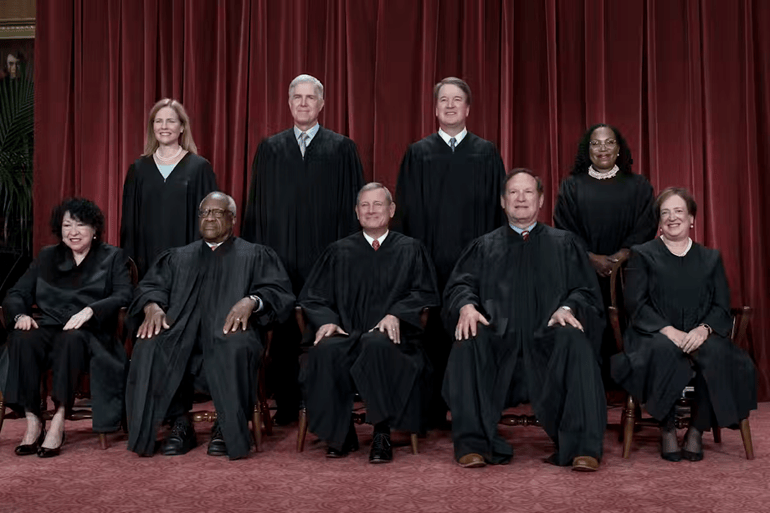
Clarence Thomas identifies himself as a consistent originalist. Behind him, Neil Gorsuch and Brett Kavanagh often vote with originalist justifications but may not refer to themselves as such. Amy Coney Barrett self-identifies as an originalist but does not necessarily vote that way. Judge Barrett attributes two principles to originalism:
“First, the meaning of the Constitutional text is fixed at the time of its ratification. Second, the historical meaning of the text “has legal significance and is authoritative in most circumstances.” Commitment to these two principles marks the most significant disagreement between originalists and their critics. A nonoriginalist may take the text’s historical meaning as a relevant data point in interpreting the demands of the Constitution, but other considerations, like social justice or contemporary values, might overcome it. For an originalist, by contrast, the historical meaning of the text is a hard constraint.”
From Congressional Originalism, co-authored by Amy Coney Barrett & John Copeland Nagle, 2016
In this context, Originalism can be equated to the Christian religions which believe in the inerrancy of the Bible. The Book of Genesis tells a creation story in which mankind and the world were created in six days. This is not a metaphor for a supreme being which allowed the human animal to evolve over time. This means that Adam and Eve walked the earth and each of us is a biological descendant from them. The narrative is not open to interpretation. So it goes with originalism and the U.S. Constitution.
Originalism has an appeal though when you consider the alternative. The alternative is to subordinate the text of the U.S. Constitution to what you, the judge, consider the relevance or irrelevance of the Constitution to a particular case in front of you. The Constitution could be a guideline or it may not. It might be one data point in a host of facts and issues that should be considered in a decision. It’s up to you. If we allow this subjective environment to thrive, the country would drift further and further away from a Constitutional democracy with each passing year since, obviously, we move further away from 1787 every year. Judges would make stuff up as they went along and our legal system would exist at the mercy of the collective idiosyncrasies of the judges who serve at any given time.
But many theoretical constructs have such an appeal. Communism and socialism are very appealing in theory. It would be wonderful if all the haves shared their good fortune with the have-nots. There would be no poverty, there would be universal high-quality healthcare, there would be an end to hunger. But the appeal only applies in theory, not in practice. Communism doesn’t work because for it to work the system would need to be managed by an incorruptible central government. We human beings may be capable of being incorruptible as individuals but we are eminently corruptible as a group. Communism fails because when the haves send their wealth to the central government for redistribution, that wealth never really gets redistributed. It tends to stay with the central government.
Originalism is a nice theory, and I am willing to admit that Amy Coney Barrett tries to be a sincere and legitimate practitioner of originalism, but if – and it’s a big if – she succeeds, she’s the exception. Barrett’s detractors admit that when she walks into a room – every room – she’s the smartest person in the room. Maybe then she is more capable of navigating the pitfalls of putting the theory into practice. Not so with most of the other originalists and textualists on the Court.
The theory becomes corrupted in what I will call the originalist grift. This grift is not new. In fact, it is one of the oldest grifts in the world. Here is how it works. Let’s say I am the grifter and you are my mark (my victim). I need you to have confidence in me – in all I say and do – in order for my grift to succeed. My problem is that you don’t know me. You have no reason to have confidence in me. There is no reason for you to follow what I say or do even if what I say makes sense at a first glance. How do I change that?
Well, one way is for me to figure out who you do respect and to convince you that I somehow represent that man, or being, or institution. Throughout history there have been hundreds of religions that thrived this way. Consider the faith healer. You, the mark, are sick, ailing, and desperate for a solution. I tell you that I represent God, and for a small donation, I will lay my hands on you and because God works through my special relationship with Him (a relationship that is not available to you) you will be healed. It works more often than you would think. Turn on your television next Sunday. Watch the televangelists preach to the thousands gathered in their stadiums. Look closely at the suit the preacher is wearing. That’s not off-the-rack crap from J.C. Penney. That’s tailor-made Italian fashion sent straight from heaven.
In the same way there are many conservative judges – SCOTUS judges – who play the originalist grift. In the context of the U.S. Constitution, the Supreme Court originalist judges announce they are channeling the Founding Fathers. They represent the Founding Fathers. They are telling us what the Founding Fathers were thinking in 1787 when the Constitution was ratified and what they were thinking in 1791 when the Bill of Rights was passed – because they know. You, the mark, do not know and therefore must respect what they decide.
As I said, I am not refusing the possibility that there are legit originalists out there. Barrett may be one. But there are many examples of grifting SCOTUS judges who allow their bias to decide cases under the guise of “this is what the Founding Fathers were thinking when they wrote the Constitution.” They are only originalists when it suits a decision they want to make. When the desired decision calls for a different reasoning, they abandon their originalist principles. Consider the following cases.
Supreme Court Cases in Which Originalists Violated Originalism
District of Columbia v. Heller
For a full explication of the sheer lunacy of this decision, see this website (www.barton.buzz) for two of the early essays entitled Guns (posted on August 8, 2022), and Guns Redux (posted on July 21, 2022). [Keep hitting previous page on the bottom right.]
The Heller decision came down on June 26, 2008 and it ushered in the modern period of America’s completely insane gun policies. In Heller, Justice Antonin Scalia (may God rest his grifting soul), decided it would be a good idea to reverse 217 years of America’s gun laws. Scalia and his fellow grifting jurists were able (maybe through a séance they had with Jefferson, Franklin, Madison, Adams, and the rest of the guys) to understand what the Founding Fathers really meant when they wrote the second amendment in the Bill of Rights, and with that understanding, rejected what 217 years of Supreme Court justices believed about the second amendment. Scalia decided that the second amendment really means that virtually all firearms (short of tanks and maybe bazookas) should be available for sale to mostly all citizens at all times. No limitations in terms of gun type or volume. Even open carry laws, which allow a citizen to walk about town with an AR-15 slung over his back is acceptable under Scalia’s divination of James Madison’s mindset.
Despite his contention that he understood the Founding Fathers’ intentions better than all his predecessors on the Court, Scalia ignored: 1) the actual wording of the second amendment (so much for textualism); and 2) the environment around the First and Second Continental Congress, the Confederation Congress, and the first United States Congress that wrote the U.S. Constitution and the subsequent Bill of Rights. In allowing an unfettered “right” to buy an arsenal of automatic weapons, Scalia ignored the clause in the second amendment that imposes the context of a militia, and he ignored the legislative environment at the time in which the Founding Fathers worst fears were obvious: the U.S. had no army and no way to defend itself other than asking its private citizens to buy guns and have them at the ready in case they were called up to serve in their state militia. These 1791 facts were not convenient to what Scalia wanted to do. So he ignored them.
As an aside, I actually do have a way of channeling the Founding Fathers in the dead of night and I did bring up the issue of the second amendment with them. The other night I gathered all the ghosts of the 90 members of the entire U.S. First Congress in my bedroom and I asked them, “in the Bill of Rights, did you intend private citizens 200 years from now to have a right to own automatic weapons that can fire 30 bullets in 4 seconds, when in fact the U.S. had the largest, most powerful standing army that could land anywhere on the planet in a matter of hours?” Jame Madison, looked at me and said, “No. I wrote the Second Amendment because we needed an army to defend the nation, the Federal Government had no money, so the only alternative was to encourage citizens to buy their own guns so that they could staff a militia if necessary. If indeed it is true today that the U.S. has a standing army that is the most powerful in the world, there is no need for individual citizens to own guns.” It’s true! James Madison actually appeared to me in my sleep and told me this.
What? You don’t believe the First U.S. Congress appeared to me in my bedroom in the middle of the night? Really? Then why do you believe they appeared to Antonin Scalia in his bedroom?
Antonin Scalia didn’t have any more awareness of James Madison’s intentions in the Second Amendment than your local faith healer has of a supreme being. I don’t know why Scalia wanted unfettered access to guns. Maybe the NRA and the gun lobby owned him. Maybe he personally liked guns (he was an avid hunter). One thing is incontrovertible. Scalia was a master at the originalist grift. He did what Antonin Scalia wanted to do under the masquerade of channeling the Founding Fathers.
Trump v. Barbara
This is the 2026 birthright citizenship case. In this case, the Trump Administration tried to undo some of the most direct, clearly worded narrative in the entire U.S. Constitution.
The 14th Amendment to the U.S. Constitution states:
“All persons born or naturalized in the United States, and subject to the jurisdiction thereof, are citizens of the United States and of the State wherein they reside.”
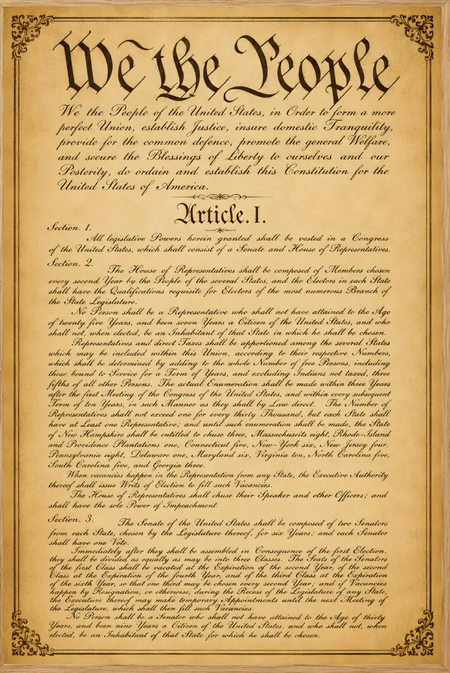
The words are pretty clear. If you’re born here, you are a citizen. A lot of people think that is a dumb idea. Maybe it is a dumb idea. But that is what the Constitution says. An originalist judge is locked into these words.
And yet, two so-called originalists on the Court, Clarence Thomas and Neil Gorsuch did exactly the opposite of what originalists swear they should not do – read things into the wording of the Constitution that are not in the Constitution. They said the 14th amendment only applied to freed blacks in the 19th century and didn’t apply to foreigners entering the U.S. in 2026 to have their babies. It is true that the 14th Amendment was written after the Civil War in 1868. And it is true that it was written with the status of recently freed black slaves in mind. But the words of the Amendment do not limit the birthright rule to recently freed black slaves.
Maybe it would make sense for Congress to prohibit birthright tourism. But they haven’t, so you know what Clarence? You know what Neil? You’re stuck with the words you have. You can’t swear by the exact words of the Constitution on Monday when it suits you, and then abandon the exact words of the Constitution on Tuesday when it doesn’t suit you. Unfortunately, Thomas and Gorsuch and other originalists do it all the time.
Learning Resources, Inc. v. Trump
This is the SCOTUS case that struck down Trump’s worldwide tariffs in 2026. Donald Trump imposed tariffs on most trading partners (and, incredibly, some countries we do not trade with) to try to curb illegal immigration, trade imbalances, and fentanyl smuggling. The Trump Administration’s problem was that the U.S. Constitution clearly conveys the government’s taxing power (and therefore the ability to apply tariffs) to Congress. Article I of the Constitution lists the powers attributed to Congress including, 1) lay and collect taxes; and 2) regulate commerce. Trump seized these powers for his own. This was a case in which the U.S. Constitution is clear and unambiguous. The decision warranted an immediate and decisive 9-0 rejection of the administration.
Trump lost the case in the Supreme Court, 6-3. Three justices, Alito, Thomas, and Kavanaugh, rejected the wording of the Constitution and ruled in Trump’s favor. Their reasoning was based in the International Emergency Economic Powers Act (IEEPA). The IEEPA is a law (not part of the U.S. Constitution) that allows the president to declare an “unusual and extraordinary threat … to the national security, foreign policy, or economy of the United States” that originates “in whole or substantial part outside the United States.” In such an emergency the president can block transactions and freeze assets to deal with the threat. The IEEPA does not allow the president to levy taxes. This was a power that the Trump Administration gave itself under the IEEPA and which the three justices agreed that he should have even though there is no basis for such a presidential power in the law or the Constitution and certainly no basis in originalist philosophy.
This case is a good example of the on-again, off-again nature of the current court’s originalist jurists. Judges Alito, Thomas, and Kavanaugh (Alito does not identify as an originalist) ignored three facts in the process of getting where they wanted to go.
- The U.S. Constitution does not allow the President to levy tariffs. An actual originalist judge would have stopped here. There should have been no reason for further consideration.
- There was no emergency that would have triggered the IEEPA anyway. The Trump Administration’s stated “emergency” was the drug problem in the U.S., a status quo that had been ongoing for the past 50 years.
- Even if there was an emergency, the IEEPA grants no such tariff authority to the president.
The fact that this Court had three dissenting judges in a case that should have been easily and quickly decided 9-0, is alarming. In too many important cases, there are at least two, if not more conservative justices who ignore case precedent, ignore the U.S. Constitution, and ignore the written law in the process of deciding a case based on personal bias.
The Mail-in Ballot Post Office case
This case was decided on September 14, 2026, a week before the writing of this essay. Since the case was taken by SCOTUS on its emergency ballot, there is no reasoning attached to the decision. The Court rejected Donald Trump’s attempt to force the U.S Postal Service to send out mail-in election ballots only to those states that submitted a list of voters to the Federal Government for approval. Trump had several objectives in his plan, none of which had to do with ensuring the integrity of the vote. The Trump Administration’s proposal was fraught with flaws:
- There was and is no election fraud problem to solve. There is no record – in any state – of illegal voting on a material scale. Trump wants to void, or at least diminish, mail-in voting because far more democrats vote by mail than republicans. We know this because he has said this on multiple occasions.
- The Post Office, by the admission of current and former employees involved in the creation of the software and management systems needed to facilitate Trump’s plan, said that the USPS was nowhere near able to handle the job. The necessary software was not completed and not tested. Moving forward would lead to a meltdown of the mail-in ballot system on November 3rd, election day. That eventuality, in the words of one USPS employee, was not a bug in the system – it was the feature.
- Even if the software was viable, there was not enough time to deploy a system in which the U.S. states would create lists of citizens, submit those lists to the federal government, have the Department of Homeland Security validate the names on the list, and then have the USPS create and mail ballots for those legal citizens in time for the citizens to complete the ballots and return them by November 3rd. (As an aside, this is the same USPS that routinely takes a full week to deliver first class mail that clients of mine send from 5 miles away)
- Article 1, Section 4, Clause 1 of the U.S. Constitution indicates that each state runs its own elections. The Supreme Court has always interpreted this “election clause” as an originalist would. The words of the Constitution mean that neither Donald Trump, the U.S. Federal Government, nor the USPS has any authority to tell states how to manage their mail-in ballot systems.
And yet, two justices, Alito and Thomas, dissented, ignoring the Constitution, evidently willing to allow an almost certain implosion of the November 3, 2026 midterm election. Justice Kavanaugh agreed with the majority, but not because he thought Trump’s proposal was unconstitutional, but rather because he didn’t think there was enough time to put the procedures in place.
Justice Alito’s dissent states: “Even assuming the rule here is a regulation of elections, Congress may create such rules under the Elections Clause. And, by statute, it may authorize the Postal Service to issue such rules,” Clarence Thomas agrees. This reasoning suggests that these two justices have totally run amok.
- First, Congress didn’t create the new rules. Donald Trump did through an executive order. The president has no power under the Constitution to mandate the DHS to validate citizenship nor does he have the power to command state governments to submit such lists to the Federal Government or anyone else.
- Second, Congress has the power to run the USPS, but it does not have the power to change a state’s election process.
The careening judicial careers of Samuel Alito and Clarence Thomas are a separate topic from originalism. Although Clarence Thomas identifies as an originalist, he routinely steps in and out of his originalist robes as a desired decision requires. Both men are overtly corrupt, unabashedly biased, and should be removed from the Court. The dangers posed by these two justices will be addressed in a separate, subsequent essay.
The next section addresses a core assumption in the originalist theory, that to define the ambiguous and imprecise sections of the Constitution, the originalist judge must educate him or herself about the individuals who wrote the Constitution, the environment in which they created the document, and how the words that they wrote would be understood in the time they lived. Given that understanding, the originalist judge can apply those ambiguous terms in today’s world. This is where the whole concept of originalism loses its validity.
The Curious Alchemy of Understanding the Founding Fathers’ “Intentions”
Just how do you gain an understanding of the Founding Fathers’ intentions? Also, did the Fathers come to a universal agreement on the ambiguous terms in the Constitution before they decided the final narrative? Or were the ambiguities in there because they couldn’t decide on a final wording? The SCOTUS originalists will tell you that they’ve studied all there is to read and yes, that having done so has given them an appreciation of what the written words meant to the writers and what it meant in the time it was written.
Wow. That is some accomplishment. I am not an historian but I have read an extensive number of historical texts about that period (1776-1800) including biographies of many of the Founding Fathers (in some cases multiple biographies of the same Father) and the impression I get is that they agreed on very little. Most of their meetings were a hot mess and in the 20 years after the war ended the U.S. was often as close to disintegration as it was in 1860.
The main political schism at the time was between the Federalists and the Republicans (the Republican Party of the 1780s was, in almost every respect, the diametric opposite of the Republican Party of the 2020s). The Federalists, led by John Adams, the second U.S. President, wanted a strong, controlling central government in which the President was granted vast powers over the country. The extremist wing of the Federalist Party would not have minded a U.S. monarch, perhaps even a relative of King George III. The Republicans, led by Thomas Jefferson, the third U.S. President, wanted more power in the states’ hands; they feared a return to the monarchy, or something akin to a dictatorship. In reality, the animosity between the two camps ran so deep that the Federalist northern states, led by Massachusetts, considered separating from the Republican southern states, led by Virginia. During the post-war period in which our system of government was conceived (1783-1800), it would not be inaccurate to say that the most famous Founding Fathers hated each other’s company. The truth is there was no Mount Olympus and these men were no gods. Their revolution and subsequent Constitution sired the most prosperous and powerful nation in human history, but let’s do a little more research before we prostrate ourselves in adoration.
The post-war polarization of the 1780s and 1790s was similar to the one that exists in the U.S. in 2026. Thomas Jefferson and John Adams and their supporters actively undermined each other’s careers. Jefferson and Alexander Hamilton despised each other since Hamilton wanted a strong central government to foster a strong central bank. Aaron Burr (who basically wanted any system of government that would have him as its leader) ended up killing Hamilton (though not over political differences). Washington was annoyed at all of them and couldn’t wait to retire to Mount Vernon. Benjamin Franklin was a peace maker but he was in his 80s during this time and was dead by 1790.
Things came to a head in 1798 when, during the Presidency of John Adams, the Federalist-controlled Congress passed the Alien and Sedition Acts. This law could have been written by Donald Trump and Stephen Miller. It was modern-day MAGA to the core. Among other things, this Act of Congress did the following:
- Allowed the extra-judicial deportation of any non-U.S. citizen the government considered to be dangerous.
- Criminalized any person or newspaper that published anything that was “false, scandalous, or malicious” against the President or Congress.
The Act was intended to stop any newspaper or person that supported Jefferson’s Republican Party. That is exactly how it was applied as over two dozen journalists (some personal friends of Jefferson) and other Republican Party supporters, were arrested.
So, one might wonder how modern-day originalists figure out what the Fathers were thinking when they wrote the freedom of the press into the Bill of Rights in 1791, and, seven years later, wrote into law the Alien and Sedition Acts of 1798. I find it hard to square that circle, though I am sure Clarence Thomas could come up with something.
The Alien and Sedition Acts ended up being the undoing of John Adams and his Federalist Party. Thomas Jefferson was elected to the Presidency two years after the Act’s enactment, followed by James Madison and James Monroe, both Republicans. It was a quarter century of repudiation. The Federalist Party never recovered.
Originalist judges might also want to giver further scrutiny to a few other Founding Father stories.
The first story doesn’t have anything to do with the Constitution but it does speak to the danger of imposing some sort of holy primacy to “the environment” and “what they were thinking” in regard to twenty-first century jurisprudence. In his book Thomas Jefferson; The Art of Power, Jon Meachem conveys a story about how the final wording of the Declaration of Independence was decided. PAY ATTENTION, YOU TEXTUALISTS!
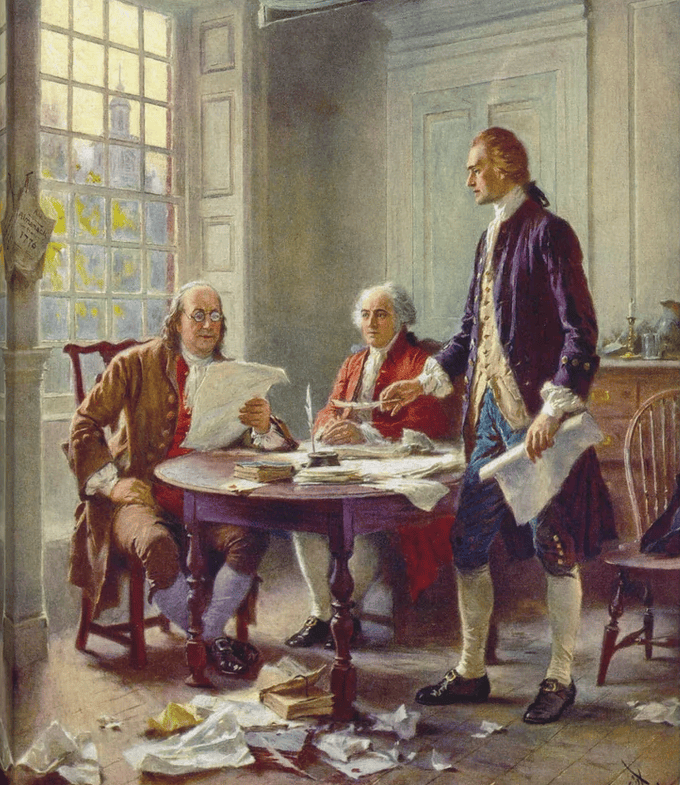
In early June, 1776, the Second Continental Congress assigned the task of writing the Declaration to a committee of five: Benjamin Franklin; John Adams; Thomas Jefferson (this was well before the relationship between Adams and Jefferson fractured); Robert Livingston; and Roger Sherman. Franklin and Adams let Jefferson write the document since his writing skills were already well-known. Jefferson submitted his draft to the committee before they submitted it to the entire Congress. The committee made a few minor adjustments and submitted the Declaration to Congress for revision and approval on June 28, 1776. A free-for-all ensued in which most of the 56 congressmen, realizing the importance of the document, wanted their two cents inserted. Arguments raged over each sentence with some wanting a softer tone and others insisting on an aggressive final break with Great Britain. Franklin intentionally seated himself next to Jefferson in Independence Hall during the debate to ensure that Jefferson didn’t explode while listening to the arguments.
Then came July 2, 1776. At that time, there was a horse stable next to Independence Hall at 6th and Chestnut Street in Philadelphia. Although the day was not terribly hot, the windows of the room were open since it was summer. As the argument over the Declaration’s wording entered its fourth day, the room was suddenly beset with horse flies from the neighboring stables. The horse flies set upon the Congressmen, biting them through their silk stockings, making continued debate untenable. They therefore decided to end the discussion and approve the Declaration of Independence, perhaps our nation’s most sacred document. Therefore, the three greatest factors that exerted the most influence over the wording of the Declaration of Independence were, in order of importance: 1) Thomas Jefferson; 2) horse flies; and 3) the Second Continental Congress. The Declaration was signed two days later on July 4th.
A textualist therefore, upon completing his due diligent research to understand what the Fathers were thinking when they created the Declaration, should conclude the following: 1) Question: What was the environment that surrounded the wording of the Declaration of Independence? Answer: horse flies; and 2) Question: What were the creators of the document thinking when they decided on the final wording of the Declaration? Answer: To get the hell away from Independence Hall and its horse flies as fast as humanly possible.
A more relevant (and maybe less sarcastic) bit of history comes to us from the correspondence between Jefferson and Adams after their respective retirements. Sadly, the two men’s enmity endured throughout the entirety of their presidential administrations (1796-1808). They had had a friendship and mutual respect as revolutionaries in the 1770s and early 1780s, but fell out completely as politicians in the late 1780s. Benjamin Rush, a mutual friend and fellow Founding Father, successfully encouraged them to mend their relationship after Jefferson’s second term ended in 1809. Though they never reconciled politically, and never physically saw each other again (Quincy Massachusetts was light years away from Charlottesville Virginia in 1810), the two men started a letter correspondence that lasted until their deaths, which incredibly occurred on the same day, July 4th, 1826, the 50th anniversary of the country they founded. They discussed many things in their letters, and relived many memories. In a letter dated August 10, 1815, Thomas Jefferson wrote the following to John Adams:
“On the subject of the history of the American revolution, you ask who shall write it? Who can write it? And who will ever be able to write it? Nobody. Except merely its external facts. All its councils, designs and discussions, having been conducted by Congress with closed doors, and no member, as far as I know, having even made notes of them, these, which are the life and soul of history must forever be unknown.”
Thomas Jefferson, extracted from a letter to John Adams, August 10, 1815
Now, I don’t want to pretend to fully understand what Thomas Jefferson was thinking when he wrote this, but maybe the originalists, if they’re sincere and objective, might understand that Jefferson is undermining the entire concept of originalism. Jefferson, in his text, is saying that no one took notes, there are no minutes, and what was discussed – the environment, their intentions, their thinking – must forever be unknown.
There is no reply from Adams in which he says, “No wait, I think John Hancock took notes.” There are however, over 200 years of Supreme Court Justices who lacked the arrogance to assume they could crawl into the minds of those men in Philadelphia in 1787.
Other writings of Jefferson confirm his contention that even the written words of the time do not convey the truth of what really happened. Regarding biographies on Adams and Hamilton that were appearing in the early 1820s, Jefferson wrote:
“Besides the five-volume libel which represents us [i.e. the Republicans] as struggling for office, and not at all to prevent our government from being administered into a monarchy, the life of Hamilton is in the hands of a man who, to the bitterness of a priest, adds the rancor of the fiercest of Federalism. Mr. Adams’ papers too, and his biography, will descend of course to his son, whose pen, you know, is pointed, and his prejudices not in our favor. And doubtless other things are in preparation, unknown to us. On our part we are depending on truth to make itself known, while history is taking a contrary set which may become too inveterate for correction.”
I don’t think it would be unreasonable to assume that Thomas Jefferson would be highly skeptical that a judge in 2026 could understand the true historical meaning of a 1787 text – that is, its environment, what was intended when the text was written, what was discussed before it was written, and what arguments were settled that led to the text – or, in other words, the truth of the text. In the excerpt above Jefferson seems to have little confidence that the truth of what happened would be known in his own time, let alone 250 years later.
Conclusion
An originalist might say this essay completely misunderstands what originalism sets out to do. True, an originalist judge in 2026 does not purport to say in his decision, “this is what James Madison was thinking when he wrote the second amendment in the Bill of Rights.” But when an originalist analyzes the environment of 1787 he must – because he has no choice – make assumptions about what he reads and reach conclusions after prioritizing the available evidence. We have a word for this. The word is interpretation.
A true originalist sees the Constitution as a set of boundaries. It says what it says and if you start thinking, “well, we need to interpret what it says, so maybe it says something other than what the words actually say,” then you are writing your own constitution.
I agree with that to a point. Judges are not supposed to legislate. They are not allowed to add their own amendments to the Constitution. To do so would be to abandon the Constitution.
My criticism of originalism is in what I see as a rampant usurpation of the originalism theory. I see far too many cases in which Supreme Court justices vote, not according to some judicial philosophy, but rather according to their personal bias. They then attribute their vote to the inerrancy of the Constitution. My question usually is, “how do you get from the words of the U.S. Constitution to your vote on this issue, which either clearly contradicts the Constitution or is not at all discussed in the Constitution? In the Court cases cited above, we repeatedly see ‘’originalist” Supreme Court justices ignoring not only the environment of 1787, but, incredibly, the written words of the document that they pretend to revere. No doubt they would say that they crawled into Thomas Jefferson’s head and divined what he was thinking.
That’s not justice. That’s faith healing.
John Barton


Leave a Reply