In my job as a business analyst, I measure two types of risk, what economists call unsystematic and systematic risk. Unsystematic risk is the basket of threats that one business or one geographical region faces (e.g. a local restaurant’s competition, hurricanes in Miami, an indispensable key manager in a company retiring, etc.). Conversely, systematic risk encompasses the things that threaten all geographic regions and all businesses (global thermonuclear war, the coronavirus, etc.). For most of my life nuclear war was the go-to example of systematic risk. It’s the quintessential terminator. My generation was taught to hide under our desks when the sirens sounded; even at age 10 we knew diving under our desks would be a wasted trip.
These four essays are about systematic risk in the U.S. in 2026. I will cover the following four categories:
- The U.S. Federal Debt
- Artificial intelligence
- Climate change
- Donald Trump and the MAGA movement

These I liken to the Four Horsemen from the Book of Revelations who brought conquest, war, famine, and death – the prophetic harbingers of the end times. Melodramatic? Read on and judge for yourself. Unlike nuclear war, these systematic risks have started and are ongoing. They’re no longer a threat; they’re happening. We are experiencing the effects of climate change and the national debt, and we are on the precipice of societal change brought about by AI. They can though get a lot worse, or, if our society intervenes, they can be reversed. Which is where the fourth risk comes in. President Donald Trump and the MAGA movement are amplifying the potential damage that will be done by the debt, AI, and climate change. Trump’s is the final essay, and appropriately the most depressing.
To avoid putting the reader into a deep anxiety I’ve divided the four horsemen into four separate essays. It might be a good idea to wait a day or two between readings. This first essay is on our nation’s debt.
The First Horseman – The U.S. Federal Debt
The United States owes 38.5 trillion dollars. Let’s put that in perspective. Let’s say your household annual income (including your salary, your spouse’s salary, etc. – everything you bring in per year) is $100,000. The U.S. government brings in about $4.6 trillion in annual tax revenue, meaning the United States’ total debt is about 8.25 times its income. If your household debt correlated with the U.S. debt, your household would owe $825,000. With an annual household income of $100,000, your net after-tax income might be about $85,000, or about $7,100 per month in take-home pay. Out of that $7,100, you’d be paying about $5,200 in debt principal and interest payments, leaving $1,900 for everything else. Obviously, you’d be in deep financial trouble. That’s the point. The United States is in deep financial trouble.
Another way to look at the federal debt is to say that every single man, woman, and child in the U.S. personally owes $111,765. The baby born in your local hospital one minute ago came into the world owing $111,765. It’s the American citizen’s original sin.
Each year, the U.S. government adds about $1.8 trillion to the $38.5 trillion. That’s in a year of normal budgeting. When politicians decide to ingratiate themselves with the public and give a tax break, like in 2017 and in 2025, trillions more are added to the debt because politicians never decrease spending to pay for the tax cut; in fact, they always increase spending while decreasing income. When a systematic event happens like COVID or the 2008-09 financial collapse, trillions more are added to the debt since the government becomes obligated to infuse cash into the economy to prevent a meltdown.
Economists also measure the federal debt as a percentage of the nation’s gross domestic product (GDP). GDP equals the total dollar amount of goods and services produced by the nation in one year. The U.S. GDP in 2025 was about $31.5 trillion. A rule of thumb in global economics is that when a nation’s debt to GDP ratio exceeds 80%, you should start to worry. When it exceeds 100%, you should start to really, really worry. As of today, the U.S. debt to GDP ratio is 121%. It’s time to panic.
First, let’s look at the economics of owing $38 trillion. The pie chart below reflects the 2025 federal budget outlays in each general category.
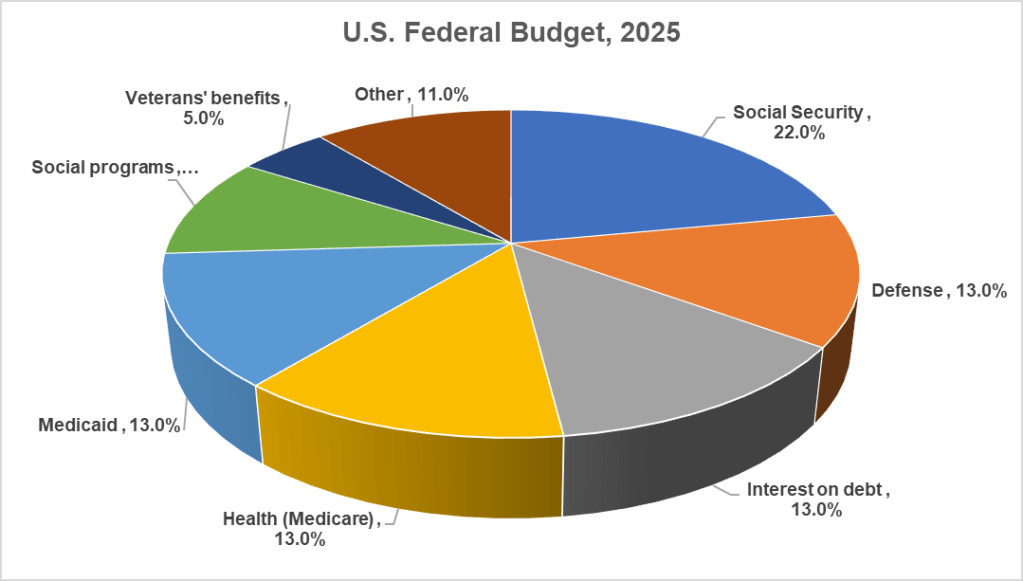
We now spend as much on the debt’s interest as we do on defense. Ditto with Medicare. As late as 2017, interest expense consumed only 7.0% of the U.S. national budget. Next year, interest on the debt is anticipated to consume 15.0%, more than twice the 2017 level. Interest payments are taking up bigger pieces of the budget pie for two reasons: 1) the national debt has increased over the past 10 years; and 2) the interest rates on that debt increased dramatically. As a country, we have become that person who has run up so much credit card debt that he struggles just to pay the monthly interest and has no ability to pay down the principal.
In addition to the usual deficit spending that we allow each year, three things happened between 2017 and 2026 that changed the federal debt from an economic concern to an economic crisis. First, the Trump Administration passed the 2017 Tax Cuts and Jobs Act (TCJA) which cut the U.S. corporate income tax rate from 35% to 21% and lowered individual tax rates as well. It was a windfall primarily for the wealthiest Americans during a period of economic expansion (it is a basic premise of economics that governments should raise taxes during economic expansionary periods and lower taxes during economic downturns; modern politicians lower taxes during both recessions and expansions). The TCJA will add about $4.0 trillion to the debt through 2035.
Then came COVID. The Trump and Biden Administrations, in separate cash infusions necessitated by the economic collapse during the COVID pandemic, added about $5.6 trillion to the national debt. The Trump cash infusion was arguably unavoidable. The Biden infusion in March of 2021 was arguably unnecessary, and certainly untargeted. Either way, this spending changed the U.S. from the really-worry category to the panic category. Now the second Trump Administration passed the “Big Beautiful Bill” of 2025, which is forecast to add another $4.0 trillion to the debt over the next ten years. The tax reduction in the 2025 bill was flat out irresponsible.
Why is the federal debt so concerning that we should worry more about it than we do a nuclear war? After all, unlike individual households, the government can print money, money that can be used to pay down the debt. There are many reasons we should worry. Some are economic/financial, others are behavioral. If the microeconomic risk didn’t scare you (that is, the fact that you personally owe $111,765), then maybe the macro side of the discussion will scare you. Without getting into a field of economic weeds, here are two things that have already started happening.
First and foremost, higher federal debt drives higher inflation. The government borrows money so it can spend it. Some of the spending is indirect (i.e. it keeps lowering our taxes, which we turn around and spend since we have more to spend). The rest it spends on social security benefits, defense, Medicare, etc. The higher spending means higher demand. Higher demand leads to higher prices. That is the cycle of how inflation happens. The reason the Feds mailed us checks during COVID was to get us to spend money so that products could still be produced, people would still have jobs and incomes, and the economic cycle would continue to spin. But too much stimulus too fast leads to too much spending. By June of 2022, the inflation rate, which had been under 3.5% for years, jumped to 9.1%. You have already experienced this at the grocery store. One U.S. dollar in 2026 buys about 80.0% of what it bought in 2020. Put another way, if you spent $100 each week on food at the grocery store in 2020, that same cart of food in 2026 is costing you $125.
The second threat is the replacement of the U.S. dollar as the world’s reserve currency. Most of our country’s international soft power stems from the financial clout we wield as a result of having the strongest, safest, most reliable economy – and therefore currency – on earth. For example, when Saudi Arabia sells oil to China, the oil is denominated in U.S. dollars. This is true for most countries trading most commodities. The world, at least up to now, is confident that the U.S. economy is the most stable and reliable in the world. Hence, our currency will have the least volatility, which affords commodity trades a lower level of risk than trades denominated in the yuan, riyal, peso, or even the euro.
The soft power stems from the fact that any trade using the dollar needs to comply with all U.S. laws and, most importantly, U.S. sanctions – even trades that have nothing to do with the United States. Saudi Arabia cannot sell dollar-denominated oil to North Korea because the U.S. (along with other western economies) has placed political sanctions on North Korea. The U.S. can, and has consistently, used this dollar power to punish countries with which it has political disputes.
The problem is the higher the U.S. federal debt, the greater the instability of the U.S. economy and the U.S. dollar. Consistently high inflation means a lowering of the dollar’s value. A country that continues to spend money it doesn’t have will eventually lose its reputation as the world’s safest economic haven. Thirty years ago, the United States was the most eligible bachelor in town. Today, we are closer to becoming the town drunk.
China, our largest economic adversary, would love for the yuan to replace the dollar as the world’s reserve currency. President Xi would be insane not to covet the soft economic power that the U.S. now wields. China is therefore doing everything in its power to ensure that the U.S. debt and its resultant instability keep rising.
There is, though, a behavioral aspect to debt risk which makes addressing the risk more than a matter of deciding to live within our means. We the people are addicted to debt. We’re addicted much in the same way that a junkie is addicted to heroin, or an alcoholic is addicted to liquor. Stopping the addiction would mean assuming a level of pain that the U.S. electorate is incontrovertibly unwilling to tolerate. We feel entitled to a lifestyle that the $38 trillion has given us. Reducing that lifestyle is just out of the question.
Let’s say the Federal government decided to reduce the debt to just 80.0% of GDP – a level at which we would only have to worry about it instead of panicking over it. To do that, we would have to pay down $13 trillion dollars. That would involve both a dramatic reduction in federal spending as well as a dramatic increase in tax rates. The defense budget would have to be cut. Retirees who depend on the social security payments would see those payments reduced or eliminated (which may happen anyway in 2033). At the same time those retirees would lose much of their Medicare insurance. Needless to say, education, infrastructure, social welfare, healthcare (such as it is), the arts, etc. would also be curtailed.
Imagine yourself running for public office. You announce this platform: “My plan is to increase your income tax rate to 50% and I am going to cut spending for school lunches, federal infrastructure, defense, Medicare and Social Security, and anything else I can get my hands on.” The behavioral risk of the debt lies in the fact that while as individuals we may have the resilience to reform our personal bad behaviors, as a group we do not. I am all for the government raising taxes on you. I am all for cutting the federal spending that affects you. Just don’t do it to me.
The long-term effects of this debt spiral will devastate the U.S. economy. The dollar will slowly decline in value, causing a rise in inflation, especially if the government resorts to printing money, which it will probably have to do. The dollar will lose its status as the reserve currency, and the United States will lose its place as the world’s soft power hegemon. In the end, federal spending will be slashed and taxes will rise anyway. The end of the road for a raging alcoholic is either a rehabilitation facility or the morgue. If he fails to choose the former, the latter will be thrust upon him. The problem is that our children and grandchildren – people who were not alive to enjoy the party while it lasted – will pay the price.
- John Barton
 The D'Town Essays
Leave a comment